From the London premiere of *The Inside Man* to the culture of German dubbing: Why international localization requires much more than just a correct translation.
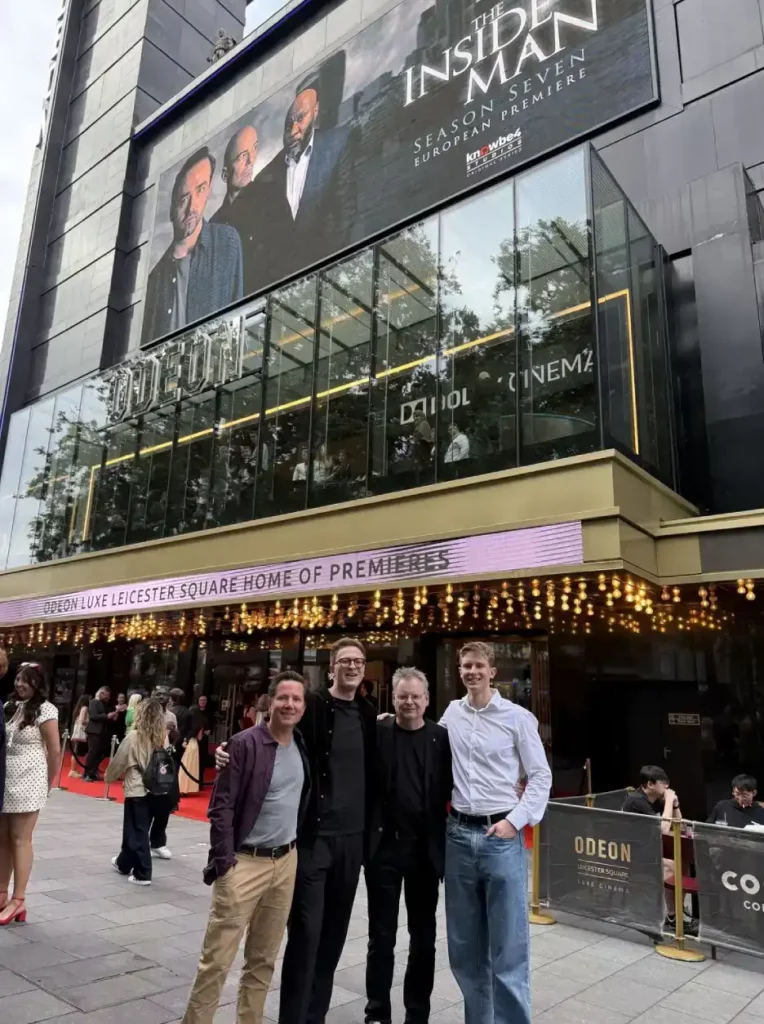
Leicester Square, London. On June 1, 2026, we’re at the ODEON Cinema for the European premiere of the seventh season of *The Inside Man*. Trevor Hurst, Markus Löhr, Hendrik Radermacher, and Sebastian Adams: our VOX-OVER team in front of the show’s main backdrop. A security awareness series on the big screen. Not exactly the place you’d expect to find employee training.
But that's exactly the point. *The Inside Man* doesn't treat learning as a chore; instead, it tells a story—with characters we care about, conflicts, and humor. Season 7 even features Ving Rhames in a guest role. To ensure this works internationally, each language version has to do more than just accurately reproduce the dialogue.
Just how much more this is the case becomes particularly clear this evening, especially in conversation with the actors and actresses.
When a character gets a second voice
We talk with Abe Jarman, Benjamin Adnams, Kathryn Georghiou, and Kirsty Averton about the localization of the series. How do we choose their voices in other languages? What do we look for during casting? And how does it feel to hear yourself in Japanese?
Abe and Kathryn, in particular, are eager to hear this. The idea is exciting and a little unsettling: the face, the movements, and the acting are still their own. The voice belongs to someone else.
"I can't even imagine that. I really want to hear that!" says Kathryn.
We have the perfect example of this: our multilingual trailer for the second season. In it, the eight languages used in the audio sometimes switch right in the middle of a sentence. The character remains the same. Only the sound changes.
Why German Dubbing Culture Surprises the International Community
In Germany, this practice is taken for granted by many viewers. For decades, international films and TV series have been dubbed into German here. Many people, for example, associate Johnny Depp with David Nathan. For them, his voice is part of the movie experience, even though it isn’t the actor’s original voice.
Such associations can become so strong that well-known voice actors are even used in commercials. The association with a movie character or a Hollywood actor carries weight.
For the actors, this is an interesting shift in perspective. Their voice is part of their performance. In the dubbed version, a second person takes over this role—and thereby shapes how the audience perceives the character.

A story isn't just translated—it's reimagined
Voice actors should therefore not simply imitate the original. They must create a believable portrayal of the character—in German, French, or Japanese—using the expressive possibilities of each language.
The question isn't just: What is this person saying? It's: What are they trying to achieve? Are they hiding their insecurity? Do they really mean the compliment? Or is there a threat behind it?
This also highlights the difference between dubbing and voice-over: In a dialogue-driven series, an additional explanatory voice isn't enough. The new voice must play the on-screen role.
A good translation is the foundation for this. Professional language localization combines it with acting, visuals, sound, and cultural context. The goal is to preserve the story’s impact.
Four Things That Must Be Preserved Across Language Barriers
Appearance and Voice
In voice casting, we pay attention to vocal timbre, vocal age, and expressiveness. The voice must match the character, temperament, and demeanor of the on-screen character. A compelling individual voice is not enough; the ensemble must also work well together. In dialogues and group scenes, the characters should remain vocally distinguishable.
Emotion and Intention
Irony, arrogance, or a subtle threat are rarely explicitly stated in the text. You can sense them in a pause, an inflection, or a seemingly casual remark. During recording, voice actors must understand this intent and convey it believably. Otherwise, the content remains accurate, while the scene conveys something else entirely.
Timing and Rhythm
What sounds short in English often takes up more space in German. But the editing schedule won’t wait. Dubbing scripts must therefore find phrasing that can be spoken and that fits with pauses, reactions, and lip movements. Simply speaking faster isn’t a solution if it causes the dialogue to lose its natural flow.
Cultural Context
Idioms and puns require special attention. “Let’s blow this popsicle stand” isn’t an invitation to eat ice cream, but rather means something like, “Let’s get out of here.” Conversely, “Now we have the salad” in English would hardly elicit the same reaction as “Da haben wir den Salat.”
In *The Inside Man*, this became very specific: An episode synopsis played on the term “sting operation,” a covert operation. In the story, an agent disguised as a bee tries to gain access to a company by singing a birthday song and presenting flowers. “Sting” links the operation to a bee sting.
That doesn’t work literally in German. For the Dutch version, we found a different approach: “bij,” the word for “bee,” is also part of “bijzondere,” meaning “special.” We were able to build on this connection to create the wordplay. A different phrasing, but the same goal: to preserve the humor of the scene.
What *The Inside Man* Reveals About Modern Corporate Learning
The series must entertain while also raising security awareness. If the suspense, characters, or humor are lost in the e-learning localization, the story loses some of what motivates viewers to keep watching. Technical accuracy alone is therefore not enough.
Corporate learning doesn't have to sound like corporate learning. If you want to capture people's attention, you need relatable situations and believable characters—even in the localized version.
For Season 7, we produced six language versions: German, Italian, Japanese, Latin American Spanish, Brazilian Portuguese, and French (for France).
Our scope of services ranged from localization and voice casting to dubbing scripts and dubbing sessions, all the way through to complete audio post-production and delivery. This also included localized graphic overlays, subtitles—including SDH for the deaf and hard of hearing—as well as the delivery of MP4 master files and subtitle files.
We already handled eight languages for *The Inside Man*—Season 2, from the script through to the final mix and subtitling. The key here is the interplay: the script, the cast, the direction, and the technical execution must all tell the same story.
Europe Doesn't Need a Single Voice
Europe is geographically compact. Linguistically and culturally, however, it is not. Even neighboring markets differ in terms of which phrasing sounds natural, how humor is received, and which voices suit a character.
That’s why each adaptation requires its own set of decisions. Which English terms should be retained? How directly does a character speak? Which allusions need to be adapted? And how much synchronization does the format require?
For international companies, this means that multilingual localization doesn’t begin in the recording studio. Target markets, language variants, and technical requirements must be incorporated early in the international language production process.
This results not in one original version and many copies, but in several equivalent versions of the same story.

Good localization doesn't sound like a translation
Back to Leicester Square. For us, this evening shows what goes into a successful international production: many decisions that the audience, ideally, won't even notice later on.
The audience should listen to a character, not to their translation. They should understand the joke, feel the uncertainty, and want to know what happens next—in their own language, without any distance from the story.
Are you planning a series, a corporate video, or an e-learning course for multiple markets? We’ll work with you to determine which voices, language versions, and production steps your project requires. Let’s talk about your production.